Post-Intensive Care Syndrome (PICS): a complex constellation of cognitive, physical, and psychological impairments that can develop after critical illness, leading to disability, frailty, and poor quality of life
Key risk factors are (1) duration of immobility and (2) delirium.
Both are reduced by >80% compliance with ABCDEF Bundle concepts
ABCDEF Bundle: Interprofessional, evidence-based safety bundle of care principles to reduce ICU length of stay, mortality, bounce-backs, ICU delirium, coma, and physical restraint use.
Goal: allow patients to “prove us wrong” about readiness for liberation from devices, sedatives, etc.
A. Assess, prevent and manage pain
Uncontrolled pain increases delirium risk, limits inspiratory effort and ventilator weaning, and impairs mobilization.
Utilize pain assessment tools like the Critical Care Pain Observation Tool (CPOT): scale 0-8, with uncontrolled pain ≥ 3 (points based on facial expressions, body movements, muscle tension, compliance with ventilator, or vocalization for extubated patients).
B - Both Spontaneous Awakening Trials (SATs) and Spontaneous Breathing Trials (SBTs)
SATs: daily sedative interruptions guided by RN-driven protocol (no active seizures, alcohol withdrawal, agitation, paralytics, myocardial infarction, or increased ICP).
If patient passes SAT, proceed to SBT.
If patient fails SAT (anxiety, agitation, pain, respiratory distress), restart sedation at half dose.
.SBTs: PS ventilation (Fi02 ≤ 50%, PEEP ≤ 7.5; typically 40% and 5/5) for ≥ 30 minutes
RT or provider-driven protocol with safety screen: passed SAT, O2 sat ≥ 88%, spontaneous inspiratory efforts, no myocardial ischemia, minimal vasopressor support.
If patient passes SBT, consider extubation.
If patient fails SBT (RR > 35 or < 8, O2 sat < 88%, respiratory distress, mental status change), restart full ventilatory support.
Evidence: SAT/SBT protocols liberated patients from mechanical ventilation 3 days sooner, decreased ICU and hospital LOS by 4 days, and reduced mortality at 1 year by 14% absolute reduction.
C. Choice of analgesia and sedation
Prioritize treating pain first and then adding sedation meds PRN.
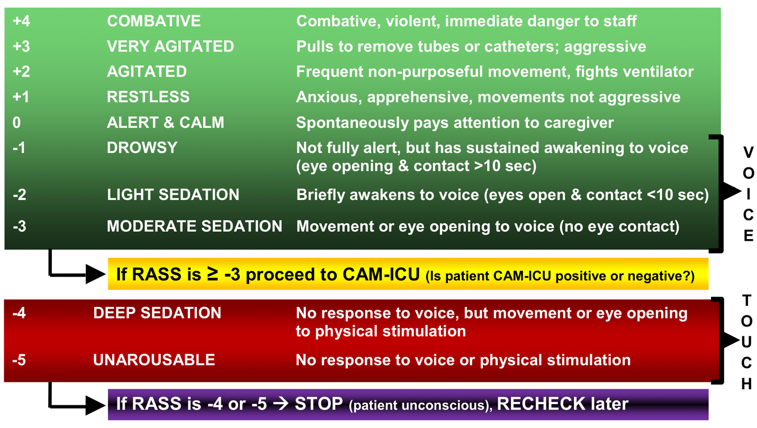
Target light sedation of Richmond Agitation-Sedation Scale (RASS) -1 to 0 to promote patients to follow commands without agitation and limit immobilization.
Prioritize dexmedetomidine or propofol over benzodiazepines which increase delirium risk.
Over-sedation: hold sedatives until target RASS is achieved, then restart at half prior dose.
Delirium affects 60-80% of ventilated patients and is associated with increased morbidity and mortality, longer ICU and hospital length of stay, and long-term cognitive dysfunction.
Risk factors and treatment: see "ICU Delirium."
E. Early mobility and exercise
Prolonged immobilization during critical illness leads to ICU-acquired weakness, associated with worse outcomes: ↑ mechanical ventilation, increased hospital length of stay, greater mortality, and greater disability.
Consult PT/OT early to initiate rehabilitation at the beginning of critical illness.
Can be done safely in patients receiving advanced support.
Rehab and interruption of sedative use is associated with reduced hospital days with delirium.
F. Family engagement and empowerment
Incorporate family at the bedside and on rounds to learn patient preferences and values, engage in shared-decision making, and address questions and concerns.
Especially important when patients are unable to communicate themselves.