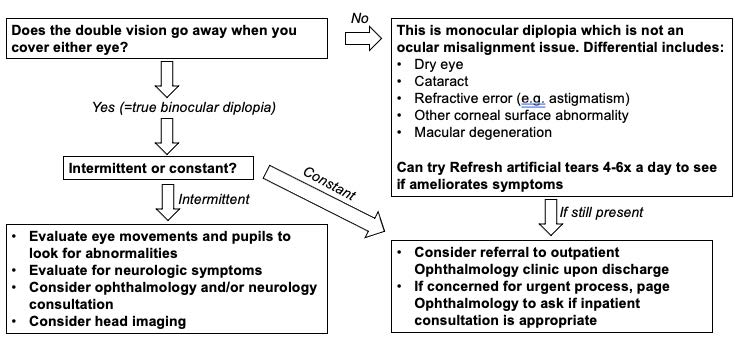
Approach to Double Vision (Diplopia)
Key Points
- Must ask if double vision goes away when covering one eye. If it does, then higher concern for ocular misalignment issue (= true binocular diplopia)
- Acute and constant diplopia requires more urgent evaluation than if intermittent
- Examine pupils and extraocular movements
- Classic complete CN3 palsy: dilated pupil, abducted and infraducted (“down and out” ) eye, ptosis. Requires immediate neuroimaging (e.g. CTA head) to rule out a compressive pathology like aneurysm
- “Pupil-sparing” CN3 lesion: the above with a normal pupillary reaction to light. Concerning for ischemic lesion rather than compression