Approach to Flashes, Floaters, Spots
Key Points
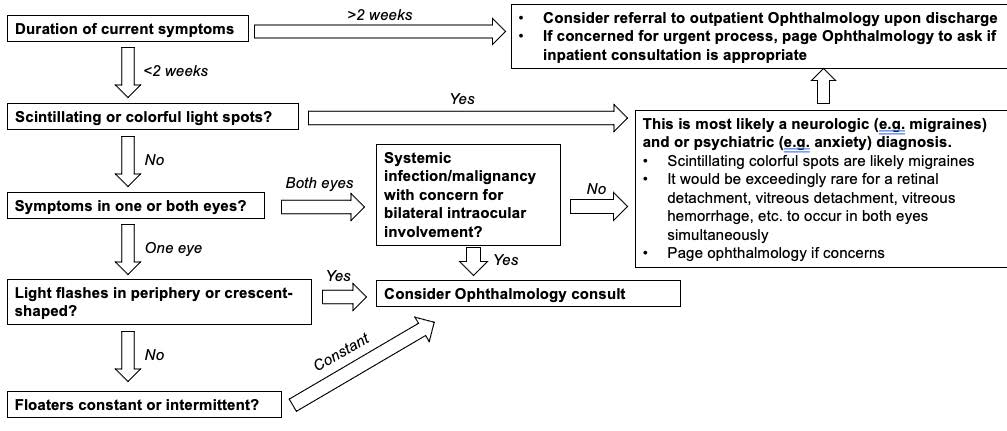
- Scintillating or colorful lights/spots, especially bilateral, are likely due to migraine; very rare for RD or PVD to occur simultaneously and bilaterally.
- Ask if visual phenomenon still present when patient closes each eye. Example: Patient reports symptoms in left eye, but they may actually be seeing in left visual field of right eye Classic retinal detachment: sudden new floaters, flashes of light, and “curtain coming down” over vision. Classic posterior vitreous detachment: sudden new floaters preceded by peripheral or crescentshaped flashes of light
- History is key: patient should have a reason for retinal detachment, e.g. diabetic retinopathy, intraocular infection, trauma, etc.
- Approach to a Red Eye
- A red ("injected”) eye occurs when the conjunctiva is vasodilated
Dry Eye
- Trace diffuse injection, blurry vision that fluctuates, gritty sensation, clears with blinking
Corneal abrasion, ulceration, or exposure keratopathy
- Unilateral, moderate to severe injection, may be diffuse or sectoral, pain, blurry vision, mucus discharge, history of poor blink rate, intubated/sedated status.
Subconjunctival hemorrhage
- Patch of bright red, often with sharp borders. Due to ruptured conjunctival vessels in pts on anticoagulation or after Valsalva (e.g., vomiting). Will resolve spontaneously without intervention
Allergic conjunctivitis
- Chemosis, mild to moderate injection, blurry vision, very itchy, watery discharge, hx of allergies/atopy
Viral or bacterial conjunctivitis
- Moderate to severe injection, scattered subconjunctival hemorrhages or petechiae, itchy or burning/painful eyes. If viral, look for preauricular adenopathy or recent URI
Acute angle closure glaucoma
- Severe eye pain with nausea/vomiting, rock-hard eye, mid-dilated and fixed pupil, blurry vision, halos around lights. May be triggered by medication use
Uveitis, episcleritis, scleritis
- Eye pain, perilimbal injection (“ciliary flush”), blurry vision. May have history of autoimmune disease. Episcleritis vs scleritis can be difficult to discern. Scleritis may have a deeper, violaceous hue
Endophthalmitis
- Eye pain, history of trauma or eye surgery, severe vision loss, history of immunocompromise and systemic infection (if endogenous)
Carotid-cavernous fistula
- Engorged and tortuous conjunctival vessels, recent history of trauma, resistance to retropulsion (will meet resistance if trying to push on the globe posteriorly)
