Temperature Abnormalities
Cairo De Souza
Hypothermia
Classification
- Mild, core temperature 32 - 35 C (89.6 - 95 F)
- Moderate, 28 - 32 C (82.4 - 89.6 F)
- Severe, <28 C (<82.4 F).
Troubleshoot: True Hypothermia?
- Ensure thermometer is “low-reading,” standard thermometers not accurate.
- Core temperature can be measured w/ bladder catheter probe or esophageal probe (may be falsely ↑ if heated oxygen being delivered). Rectal temp can be used but is less accurate.
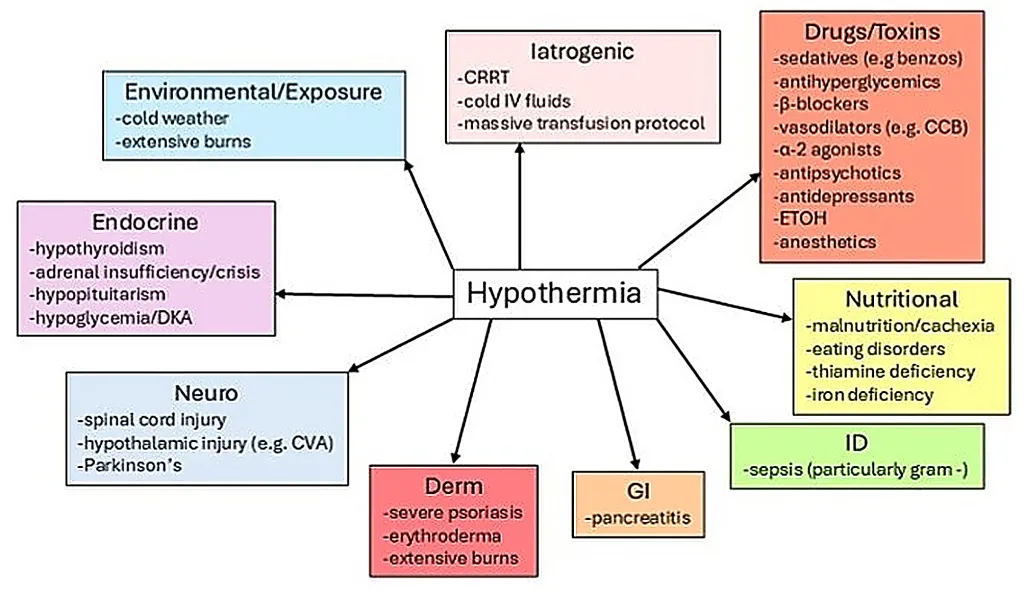
Etiologies
Evaluation
- Infectious work-up
- POC blood glucose, TSH/FT4, cortisol, lipase, UA, UDS, EtOH level, additional tox as appropriate, DKA work-up if relevant.
- Physical exam + history for exposures and trauma.
- CBC, CMP, Lactate, ABG, CK, PT/PTT, Fibrinogen.
- EKG
Management
- Treat underlying cause.
- Mild hypothermia:
- Passive external rewarming (PER): blankets, increase ambient temperature.
- Note that PER requires sufficient underlying physiologic reserve to generate heat. This is often impaired in elderly pts, malnutrition, sepsis.
- Moderate hypothermia, refractory mild hypothermia, or cardiovascular instability:
- Active external rewarming (AER): forced warm air (ie Bair Hugger), heated blankets, heat lamps, hot packs (consider burn risk).
- Bair Hugger cannot be done on floor because of initial q1h temperature checks, may need stepdown v ICU bed
- Severe hypothermia or refractory moderate hypothermia:
- Active core rewarming: Warmed IV crystalloid (limited rewarming potential unless large volume but will decrease ongoing losses), warmed humidified inspired air, warmed bladder lavage.
- More extreme methods such as peritoneal/thoracic lavage more likely to be used in severe environmental cases in ED.
- Pulseless severe hypothermia (“You aren’t dead unless you are warm and dead”):
- Continue CPR until re-warmed as severe hypothermia is neuroprotective and pts can have good neurologic outcomes despite hours of CPR.
- ACLS medications and shocks will have poor effectiveness; prioritize circulation (i.e. chest compressions) and rewarming.
- Consider ECMO (likely venoarterial if pulseless); would need transfer to surgical CVICU.
- Potential complications: Bradycardia/heart block, arrhythmias, shock, coagulopathy/DIC, rhabdomyolysis; rebound hyperkalemia/hypoglycemia with rewarming.
Fever and Hyperthermia
Background
- Fever: T >38.0°C (100.4°F) driven by hypothalamus activity in response to systemic triggers (i.e. cytokines); may use lower threshold for immunocompromised pts.
- Hyperthermia: T >41.0 C (105.8°F) uncontrolled heat production with failure of thermoregulation.
Etiologies
- Drug fever potential culprits: antibiotics (penicillins, cephalosporins, sulfonamides), anticonvulsants (phenytoin, carbamazepine, phenobarbital), allopurinol, heparin, dexmedetomidine.
Evaluation
- Infectious work-up +/- LP; may consider pan-scan if unable to identify source.
- POC glucose, BMP, LFT, Mg/Phos, CBC w/diff.
- Consider coags + fibrinogen (DIC), CK/UA (rhabdo), UDS, acetaminophen and salicylate levels, TSH/FT4, cortisol, lipase, ABG.
- Review medication list: antibiotics, serotonergic drugs, anti-psychotics, recent sedation for OR, or recently intubated with succinylcholine, dexmedetomidine.
- Consider CT/MRI head.
Management
- Treat underlying etiology
- Serotonin syndrome → stop serotonergic drugs; add cyproheptadine.
- Malignant hyperthermia → activate malignant hyperthermia team; add dantrolene.
- Cooling
- Target <38.0°C (100.4°F)
- Surface cooling: Ice (bath, or ice packs more likely in our MICU), evaporative cooling with misted lukewarm water and fan.
- Internal cooling: Cold IV fluids, dry ventilation (evaporative) with non-humidified nasal cannula or vent circuit
- Avoid shivering -> give opiates (except in serotonin syndrome), precedex, propofol, benzos, ketamine.
- Antipyretics: acetaminophen, NSAID
- Effective for most causes of fever- infection, pancreatitis, DVT/PE, pneumonitis.
- AVOID for true hyperthermia (ineffective and potentially harmful) -> neuroleptic malignant syndrome, malignant hyperthermia, serotonin syndrome, heat stroke.
- Antimicrobials, consider antifungals if fevering through BSA.
- Monitor for complications: rhabdomyolysis, DIC, arrhythmias.